
 easytaxbite
UAE Corporate Tax: The Complete 2025 Guide for Businesses
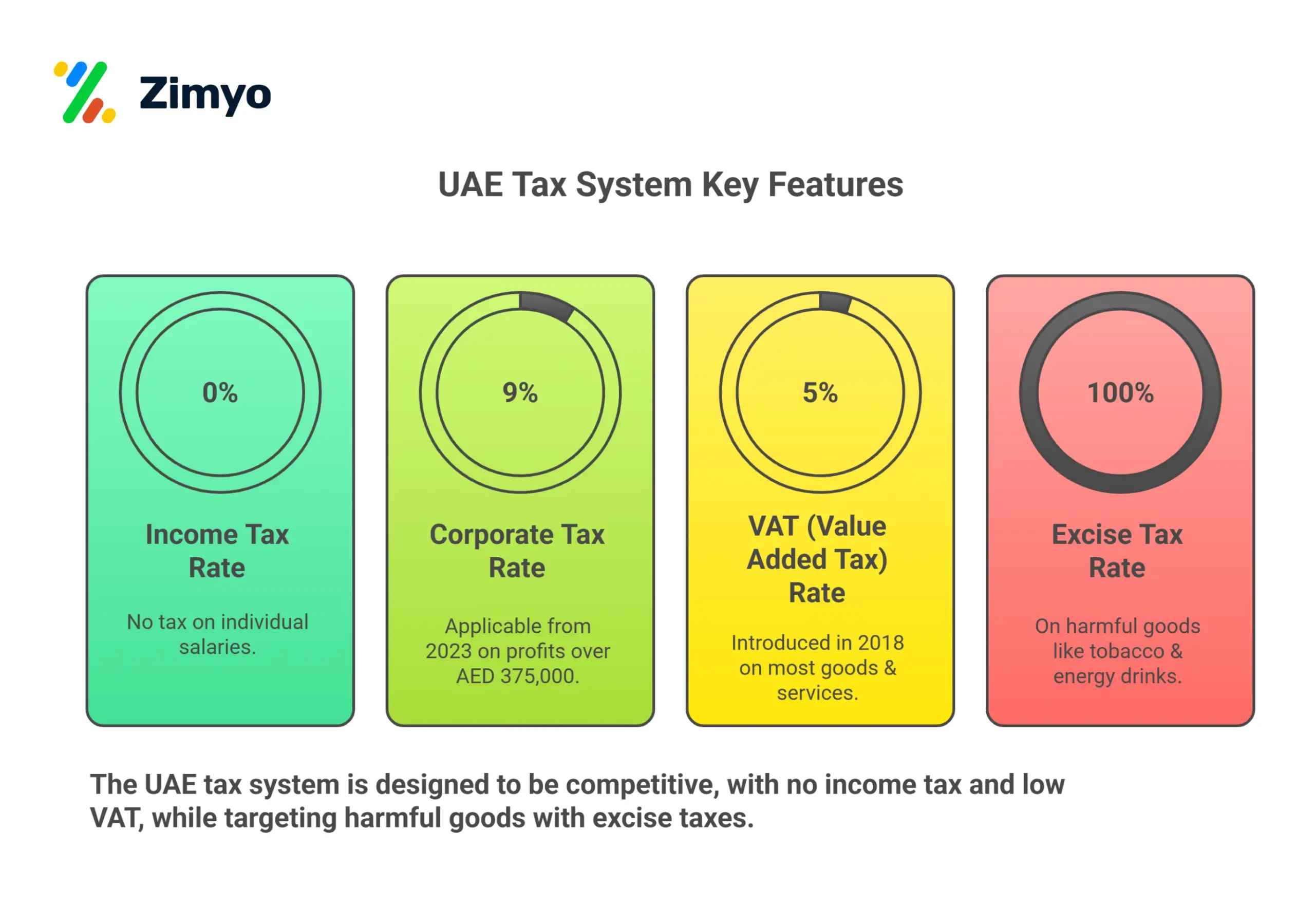
The UAE tax system features 0% corporate tax for qualifying Free Zone entities, 9% standard rate for taxable profits above AED 375,000, and 15% Domestic Minimum Top-Up Tax for large multinationals.
The End of Zero-Tax Era: What Changed in 2023
For decades, the United Arab Emirates operated as a tax-free business haven, attracting global investors with its zero-percent corporate tax policy. That changed fundamentally on June 1, 2023, when the UAE implemented its first-ever federal corporate tax regime under Federal Decree-Law No. 47 of 2022.
This wasn’t a sudden reversal of fortune—it was a strategic evolution. The UAE introduced corporate tax to align with international standards (particularly OECD BEPS initiatives), combat harmful tax practices, and maintain its reputation as a transparent, compliant global business hub while preserving its competitive edge.
The 9% Standard Rate: Who Pays What?
The headline rate is straightforward: 9% corporate tax applies to taxable profits exceeding AED 375,000 (approximately USD 102,000) annually. But the devil is in the details.
Taxable Income Thresholds
| Income Level | Tax Rate | Effective Tax Burden |
|---|---|---|
| First AED 375,000 | 0% | Tax-free |
| Above AED 375,000 | 9% | Progressive effective rate |
Example: A company with AED 1,000,000 in taxable profit pays:
- 0% on first AED 375,000 = AED 0
- 9% on remaining AED 625,000 = AED 56,250 total tax
- Effective tax rate: 5.6%
This structure deliberately protects small businesses and startups while ensuring larger profitable entities contribute to the national economy.
Small Business Relief: The AED 3 Million Lifeline
Recognizing that compliance costs can overwhelm micro-enterprises, the UAE offers Small Business Relief (SBR) for businesses with revenue up to AED 3 million per tax period.
Key Benefits:
- Treated as having no taxable income (effectively 0% tax)
- Simplified compliance requirements
- Available for tax periods ending before December 31, 2026 (subject to extension)
Eligibility Criteria:
- Revenue must not exceed AED 3 million in the current and previous tax periods
- Not available to members of multinational groups with consolidated revenues exceeding EUR 750 million
- Must be a Resident Person (incorporated in UAE or effectively managed there)
- Must not be a Qualifying Free Zone Person (they have their own 0% regime)
Strategic Tip: Once you elect SBR for a period, you’re locked in for five consecutive periods. Choose wisely based on growth projections.
Free Zone Taxation: The 0% Rate Survives (With Conditions)
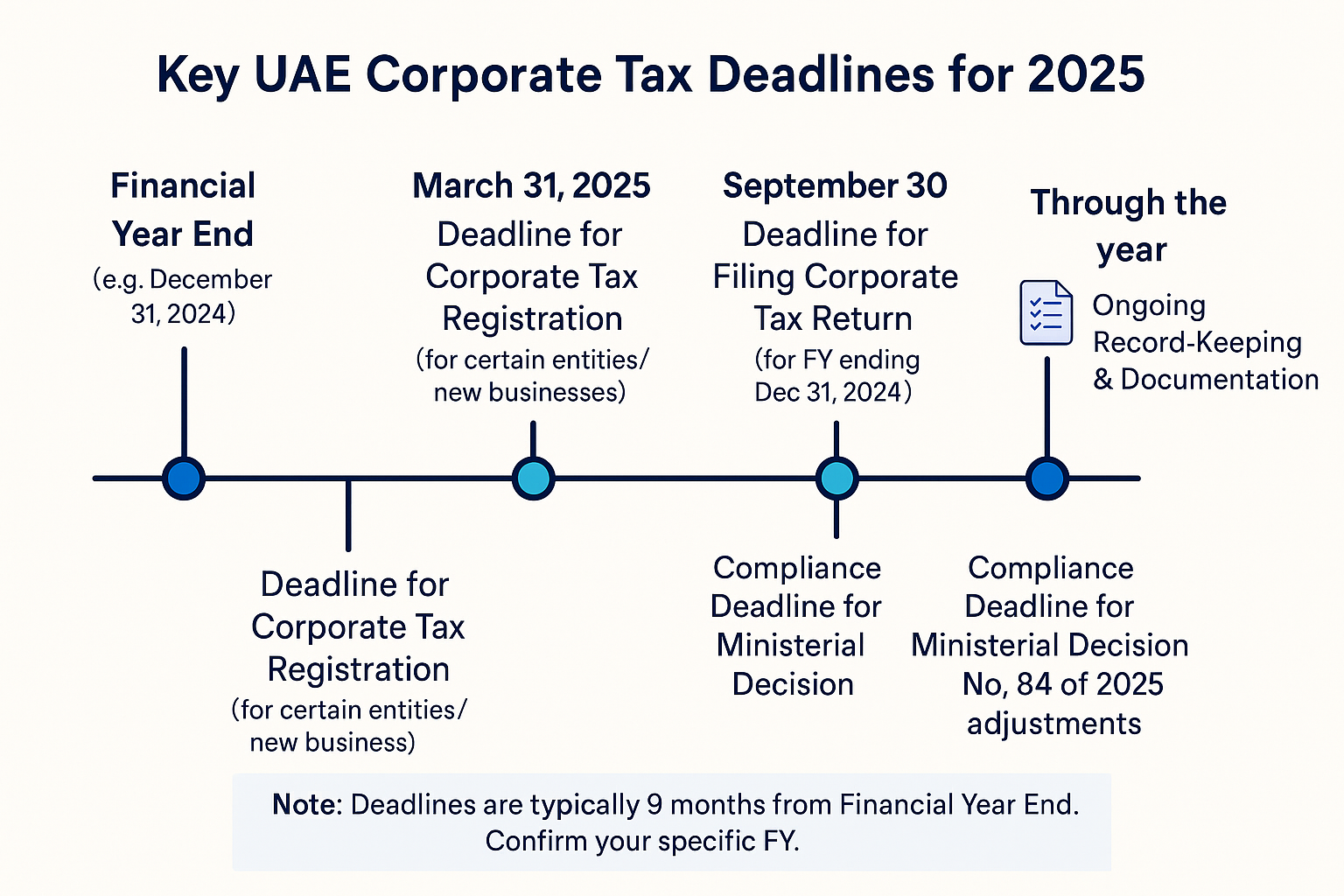
Key compliance deadlines for UAE Corporate Tax 2025: Registration within 3 months of incorporation, tax return filing within 9 months of financial year-end.
Free Zone companies can still enjoy 0% corporate tax, but it’s no longer automatic. You must qualify as a Qualifying Free Zone Person (QFZP) by meeting stringent conditions.
The Seven Pillars of QFZP Status
To maintain 0% tax on qualifying income, Free Zone entities must satisfy ALL of the following:
- Maintain Adequate Substance
- Physical office in the Free Zone (not just a flexi-desk)
- Qualified full-time employees
- Adequate operating expenditures relative to activity level
- Core income-generating activities performed in the zone
- Derive Qualifying Income
- Manufacturing and processing
- Trading of qualifying commodities
- Holding company activities
- Logistics and distribution from Designated Zones
- Headquarters services to related parties
- Fund management and reinsurance
- De Minimis Threshold
- Non-qualifying income cannot exceed the lower of:
- 5% of total revenue, OR
- AED 5 million
- Transfer Pricing Compliance
- Arm’s length pricing for related-party transactions
- Maintain master file and local file documentation if thresholds met
- Audited Financial Statements
- Mandatory IFRS audits regardless of revenue size (effective 2025)
- Must distinguish qualifying vs. non-qualifying income
- No Election for Standard Taxation
- Must not voluntarily choose to be taxed at 9%
- Timely Registration and Filing
- Register with Federal Tax Authority (FTA) within 3 months of starting operations
- File annual returns within 9 months of financial year-end
The 5-Year Lockout Penalty
Here’s the brutal truth: If you fail ANY condition, you lose QFZP status for the current year PLUS the next four tax periods. All income becomes taxable at 9% for five full years before you can requalify .
Example: A Free Zone trading company with AED 10 million revenue has AED 600,000 in mainland UAE sales (6% of total). This exceeds the 5% de minimis threshold. Result: Immediate loss of QFZP status, 9% tax on ALL AED 10 million for five years—costing approximately AED 4.5 million in unnecessary tax.
Excluded Activities: What Doesn’t Qualify for 0%
Even within Free Zones, certain activities are automatically excluded from preferential treatment:
- Banking and insurance (non-reinsurance)
- Finance and leasing (unless aircraft/ship related)
- Real estate transactions with non-Free Zone persons
- Transactions with natural persons (in most cases)
- Intellectual property exploitation (unless qualifying IP with R&D substance)
Income from these activities is taxed at 9%, and if it exceeds de minimis limits, your entire QFZP status evaporates.
The 15% Global Minimum Tax: Pillar Two Arrives (2025)
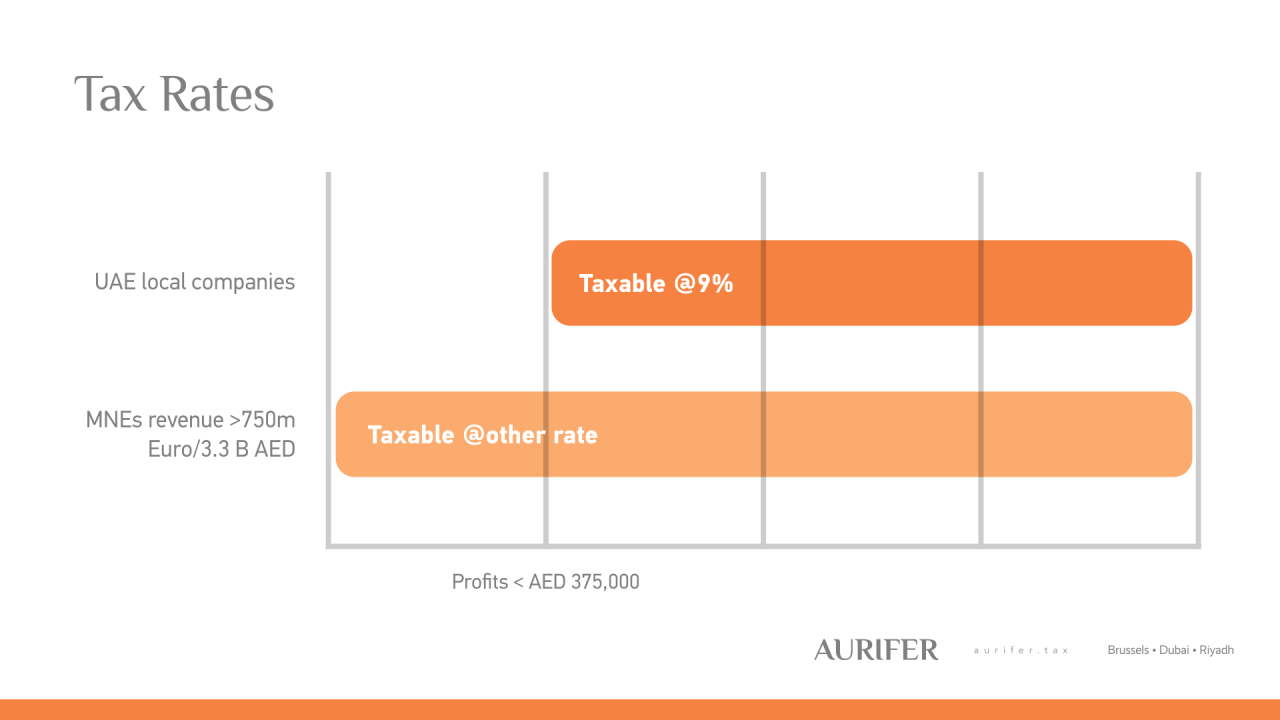
UAE Corporate Tax structure: 0% for qualifying Free Zone income, 9% standard rate for mainland and non-qualifying income above AED 375,000 threshold.
Effective January 1, 2025, the UAE implemented the Domestic Minimum Top-Up Tax (DMTT) under OECD Pillar Two rules. This impacts multinational enterprises with consolidated global revenues exceeding EUR 750 million .
How It Works:
- If a UAE subsidiary of a large multinational has an effective tax rate below 15% due to Free Zone benefits or other incentives, the UAE will impose a top-up tax to reach 15%
- This prevents profit shifting and ensures global minimum taxation
- Applies regardless of QFZP status for in-scope entities
Who’s Safe: Purely domestic UAE groups and multinationals below the EUR 750 million threshold remain under the standard 9% regime.
2025-2026 Regulatory Updates: What’s New
The UAE tax landscape continues evolving. Key recent changes include:
Federal Decree-Law No. 17 of 2025 (Tax Procedures)
- 5-year limitation period for tax refunds and credits
- 5-year audit window (extendable to 15 years for fraud)
- Binding administrative guidance from FTA
Cabinet Decision No. 129 of 2025 (Penalties)
Effective April 14, 2026:
- Late payment penalties reduced to 14% per annum (from 2% + 4% monthly)
- Fixed penalties for incorrect returns: AED 500 (first time), AED 2,000 (repeat)
- Reduced fines for record-keeping violations
Ministerial Decision No. 229 of 2025
- Expands qualifying activities for commodity trading
- Clarifies IP qualification requirements
- Reinforces de minimis calculations
Compliance Checklist: Staying on the Right Side
Registration
- [ ] Register with FTA within 3 months of business commencement
- [ ] Late registration penalty: AED 10,000
Annual Obligations
- [ ] File tax return within 9 months of financial year-end
- [ ] Pay any tax due by the same deadline
- [ ] Submit audited financial statements (QFZPs)
Documentation
- [ ] Maintain transfer pricing documentation (if applicable)
- [ ] Keep records for 7 years
- [ ] Separate qualifying vs. non-qualifying income tracking
Substance Requirements (QFZPs)
- [ ] Annual review of physical presence
- [ ] Employment contracts for Free Zone staff
